How Dating App Algorithms Match You With Other People
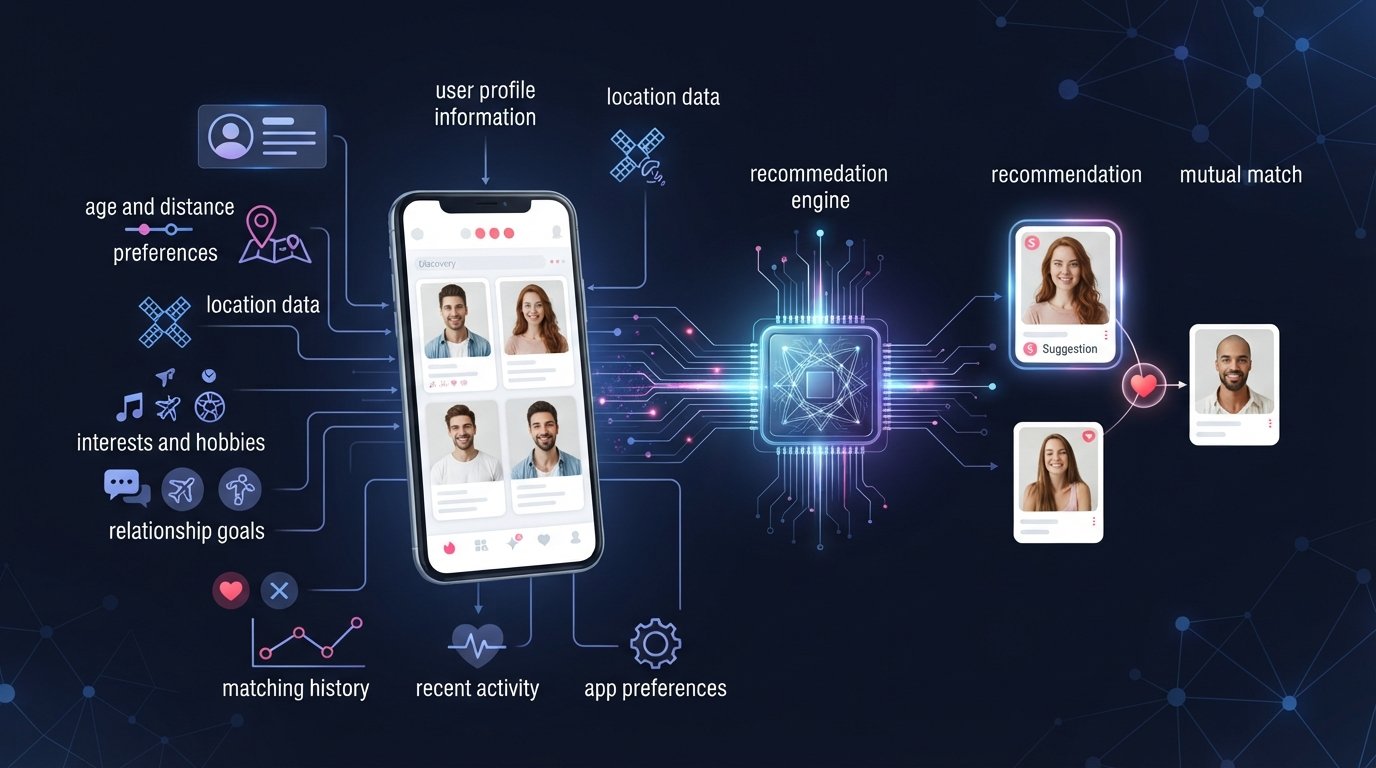
When you use a dating app, the profiles you see are rarely shown completely at random. Behind the app’s interface, recommendation and matching systems help determine which people may appear in your discovery feed, search results, or suggested matches.
These systems can consider information from your profile, your preferences, your activity, and the way you interact with other profiles. Some platforms may also use machine learning or other statistical techniques to improve their recommendations over time.
However, a dating app algorithm cannot determine whether two people will truly fall in love or build a successful relationship. It can only use available information to estimate which profiles may be worth showing you.
Understanding how these systems work can help you make better use of dating apps and understand why your recommendations sometimes change.
What Is a Dating App Algorithm?
A dating app algorithm is a set of rules, calculations, or computer models used to process information and make recommendations.
In simple terms, the system tries to answer a question:
“Which profiles are most relevant to this user right now?”
To answer that question, a dating app can evaluate different signals and then rank or filter potential profiles.
The exact formula is usually different for every platform, and companies may not publicly reveal all of the factors used by their systems.
What Information Can Dating Algorithms Use?
Dating recommendation systems can work with many different types of information.
Profile Information
The information you provide when creating or completing your profile can help the platform understand your preferences and characteristics.
This may include:
- Age
- Location
- Interests
- Education
- Occupation
- Lifestyle information
- Relationship preferences
- Profile description
Not every app collects or uses the same information.
Your Dating Preferences
Your selected preferences can influence which profiles are considered relevant.
For example, you may choose a preferred:
- Age range
- Distance
- Gender
- Relationship type
- Lifestyle characteristic
- Other available preference
These settings can reduce the number of profiles that do not match what you are looking for.
Your Interactions
Your actions inside the app can provide additional signals.
For example, a platform may observe patterns involving:
- Profiles you like
- Profiles you skip
- People you match with
- Conversations you start
- Features you use
- Profiles you interact with repeatedly
The importance of each signal depends on the individual platform.
Your Activity Level
Your activity can also affect recommendations.
An active user may generate more recent information about their preferences than someone who rarely opens the app.
For example, if your recent activity shows that you are interacting with a particular type of profile, the recommendation system may have more information to work with.
How Does the Matching Process Work?
Although the technology can be complex, the general process can be explained in a few stages.
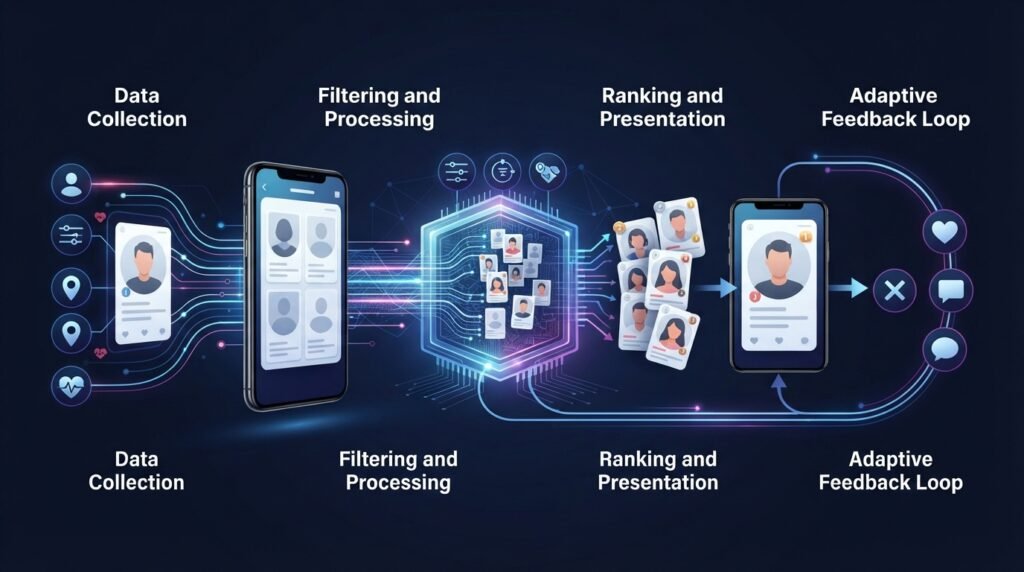
Step 1: The App Collects Relevant Information
The system starts with information from your profile, preferences, and interactions.
This creates a set of signals that can be used to understand what kinds of profiles might be relevant to you.
Step 2: Potential Profiles Are Identified
The platform considers a larger pool of users and removes or deprioritizes profiles that do not meet important requirements.
For example, profiles outside your selected preferences or distance range may be less likely to appear.
Step 3: Profiles Are Ranked
After identifying possible candidates, the system can rank them according to its recommendation model.
A higher-ranked profile may be shown earlier or more prominently than another profile.
This does not necessarily mean the person is “better.” It simply means the system estimates that the profile may be relevant to you based on its available signals.
Step 4: Your Behavior Creates New Signals
Every interaction can potentially provide new information.
If your behavior changes, the system may receive different signals and your recommendations can change as well.
This is one reason why the profiles you see today may not be exactly the same as the profiles you saw several weeks ago.
What Factors Can Influence Dating App Recommendations?
Different platforms use different systems, but several factors commonly play a role.
| Factor | Possible Role in Recommendations |
| Location | Helps identify people within a selected area |
| Age | Can be used to apply age preferences |
| Gender preferences | Helps determine relevant profiles |
| Interests | May identify shared interests |
| Relationship goals | Can help connect users with similar intentions |
| Profile completeness | Provides more information about the user |
| Likes and skips | May provide preference signals |
| Matching history | Can help identify interaction patterns |
| Recent activity | Provides newer signals about user behavior |
| App preferences | Helps filter or prioritize relevant profiles |
This table describes common possibilities rather than a universal formula. Each dating service can use its own approach.
Do Dating Apps Use Artificial Intelligence?
Some modern dating platforms use artificial intelligence, machine learning, or other automated technologies in different parts of their products.
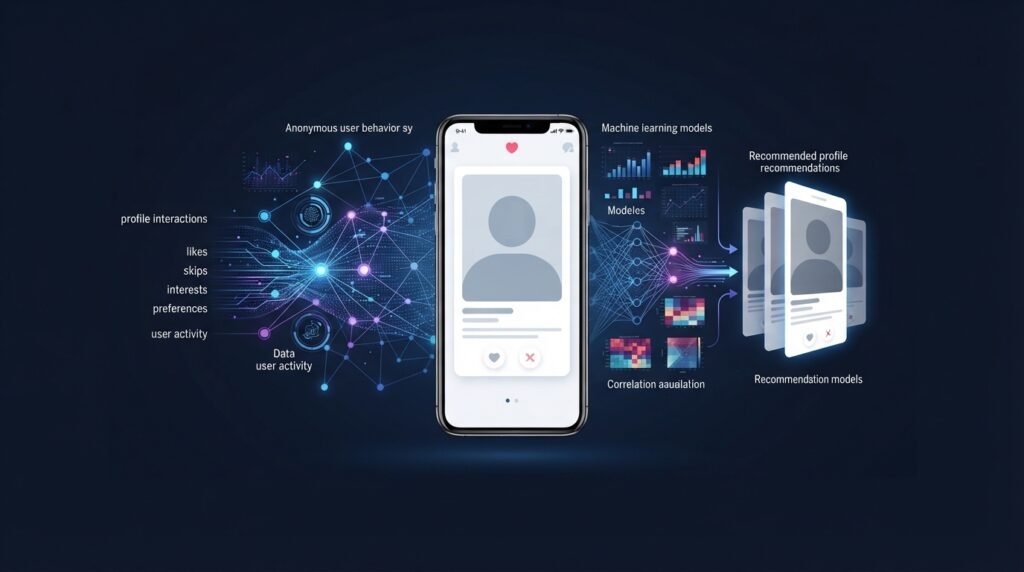
These technologies can help analyze large amounts of information and identify patterns that would be difficult to process manually.
How Machine Learning Can Help
A machine learning system can learn from patterns in data.
For example, if many users with certain behaviors tend to interact positively with certain types of profiles, a recommendation system may identify that pattern.
The system can then use those learned patterns when generating future recommendations.
However, machine learning does not mean the app understands human relationships in the same way a person does.
It works with available data and statistical patterns.
Does the Algorithm Know Who You Will Like?
No.
A dating algorithm can make predictions, but it cannot know your future preferences with certainty.
People can be attracted to someone who does not match their usual preferences. They can also discover unexpected common interests after talking to someone.
For this reason, algorithmic recommendations should be treated as suggestions rather than definitive judgments about compatibility.
Why Do Dating App Recommendations Change?
It is normal for your recommendations to change over time.
Your Preferences Change
If you update your age range, distance, relationship goals, or other settings, the pool of potential profiles can change.
Your Activity Changes
Your recent interactions may provide different signals than your older activity.
New Users Join
Dating platforms constantly gain and lose users. New profiles can therefore enter the pool of potential recommendations.
People Become Less or More Active
A profile that was active last week may become inactive, while another user may start using the platform more frequently.
The Platform Updates Its System
Dating apps can change their recommendation technology, features, or ranking methods over time.
As a result, the way profiles are presented may change even if your own behavior stays the same.
Why Do Some Profiles Appear More Often?
Seeing the same person multiple times can happen for several reasons.
There may be a relatively small number of profiles that fit your current preferences and location.
The platform may also decide that a particular profile remains relevant based on available signals.
In other cases, the person may become active again or update their profile.
Seeing someone repeatedly does not necessarily mean that the person has specifically searched for you or that the app is deliberately trying to force a connection.
Can You Improve Your Dating App Recommendations?
You cannot directly control an app’s algorithm, but you can make the information available to it more accurate.
Keep Your Profile Information Current
If your interests, preferences, or relationship goals change, update your profile.
Accurate information gives the recommendation system better signals to work with.
Use Clear Preferences
If an app provides preference controls, use them thoughtfully instead of selecting settings that do not reflect what you actually want.
Interact Naturally
Use the app according to your genuine preferences rather than trying to manipulate the system.
If you consistently interact with profiles that you are not genuinely interested in, the signals produced by your behavior may not accurately represent your preferences.
Complete Your Profile
A more complete profile can provide more information about you and give other users a clearer understanding of your interests.
Can You Trick a Dating App Algorithm?
There are many online claims about ways to “hack” or manipulate dating algorithms.
However, there is no universal trick that guarantees better matches.
Dating platforms use different systems, and they can change those systems over time.
Instead of trying to exploit an unknown formula, it is generally more useful to focus on things you can actually control:
- Use accurate profile information
- Add recent photos
- Clearly communicate your interests
- Set realistic preferences
- Interact with people genuinely
- Keep your account active if you want to use the platform regularly
These actions improve the quality of your profile and interactions without relying on questionable algorithm hacks.
Are Dating App Algorithms Fair?
Fairness is a complicated issue because recommendation systems can reflect the data and rules used to build them.
For example, an algorithm may produce different results for different users because of their preferences, location, activity, or available pool of profiles.
There can also be concerns about:
- Bias in automated recommendations
- Unequal visibility
- Data privacy
- Transparency
- How user behavior is interpreted
- How ranking decisions are made
Users should remember that an algorithm’s recommendation is not an objective measurement of a person’s attractiveness, personality, or worth.
Can Dating Algorithms Predict Compatibility?
Algorithms can estimate compatibility using available information, but they cannot measure every part of a human relationship.
A system may identify shared interests or similar preferences, but it cannot completely evaluate:
- Emotional connection
- Trust
- Communication chemistry
- Sense of humor
- Personal growth
- Shared experiences
- Real-world attraction
- How two people behave together
These factors often become clear only through genuine conversation and real-life interaction.
What Is the Difference Between Matching and Recommendation?
These terms are sometimes used interchangeably, but they can describe different parts of the dating experience.
| Feature | Recommendation | Match |
| Purpose | Suggests profiles you may like | Connects users after mutual interest |
| Timing | Usually happens before a mutual connection | Happens after compatible interactions |
| Main function | Discovery | Connection |
| Based on | Preferences, profile data, activity, and other signals | Mutual interest according to the platform |
| Guarantees compatibility? | No | No |
A recommendation helps you discover someone. A match creates an opportunity to communicate.
What Should You Remember About Dating Algorithms?
The most important thing to understand is that a dating algorithm is a recommendation tool, not a relationship expert.
It can process information much faster than a person can, but it still works with limited data.
A useful approach is to:
- Treat recommendations as suggestions
- Keep your information accurate
- Avoid obsessing over ranking or visibility
- Focus on genuine interactions
- Review your privacy settings
- Remember that human compatibility cannot be reduced to a score
Frequently Asked Questions About Dating App Algorithms
How do dating app algorithms work?
Dating app algorithms process information such as profile details, preferences, location, activity, and interactions to help recommend or rank potential profiles. The exact method differs between platforms.
Do dating apps use AI to find matches?
Some dating platforms use artificial intelligence or machine learning technologies for recommendations and other features. However, the specific technology and its role vary by app.
Does swiping affect the dating algorithm?
Your interactions may provide signals about your preferences, depending on how the particular platform designs its recommendation system. Not every app uses swiping or treats it in the same way.
Why does my dating app keep showing similar people?
The app may be finding that these profiles fit your preferences, location, or other available signals. A smaller local user pool can also result in similar recommendations.
Can I reset my dating app algorithm?
Some apps provide features that let you change preferences or reset certain aspects of your experience, while others do not. The available options depend on the individual platform.
Does being active improve dating app recommendations?
Activity can provide newer information about your preferences, but being active does not guarantee better matches. Different platforms can use activity signals differently.
Can dating algorithms guarantee a compatible partner?
No. Algorithms can recommend profiles based on available information, but they cannot guarantee emotional, personal, or long-term compatibility.
Why do dating app matches disappear?
A match may disappear because someone unmatched you, deleted or deactivated their account, or because of a platform-related issue. The exact reason depends on the app.
Conclusion
Dating app algorithms are designed to make online dating more manageable by helping users discover potentially relevant profiles. They can consider information such as preferences, location, profile details, interests, interactions, and activity when generating recommendations.
However, there is no universal dating algorithm, and no recommendation system can accurately predict every successful relationship. A profile that looks highly relevant to an algorithm may not create a meaningful connection, while someone unexpected may turn out to be an excellent match.
The best way to use dating app recommendations is to treat them as a discovery tool. Keep your profile accurate, use genuine preferences, interact naturally, and focus on the quality of conversations rather than trying to find a secret formula for the algorithm.