What Are Dating Apps and How Do They Work?
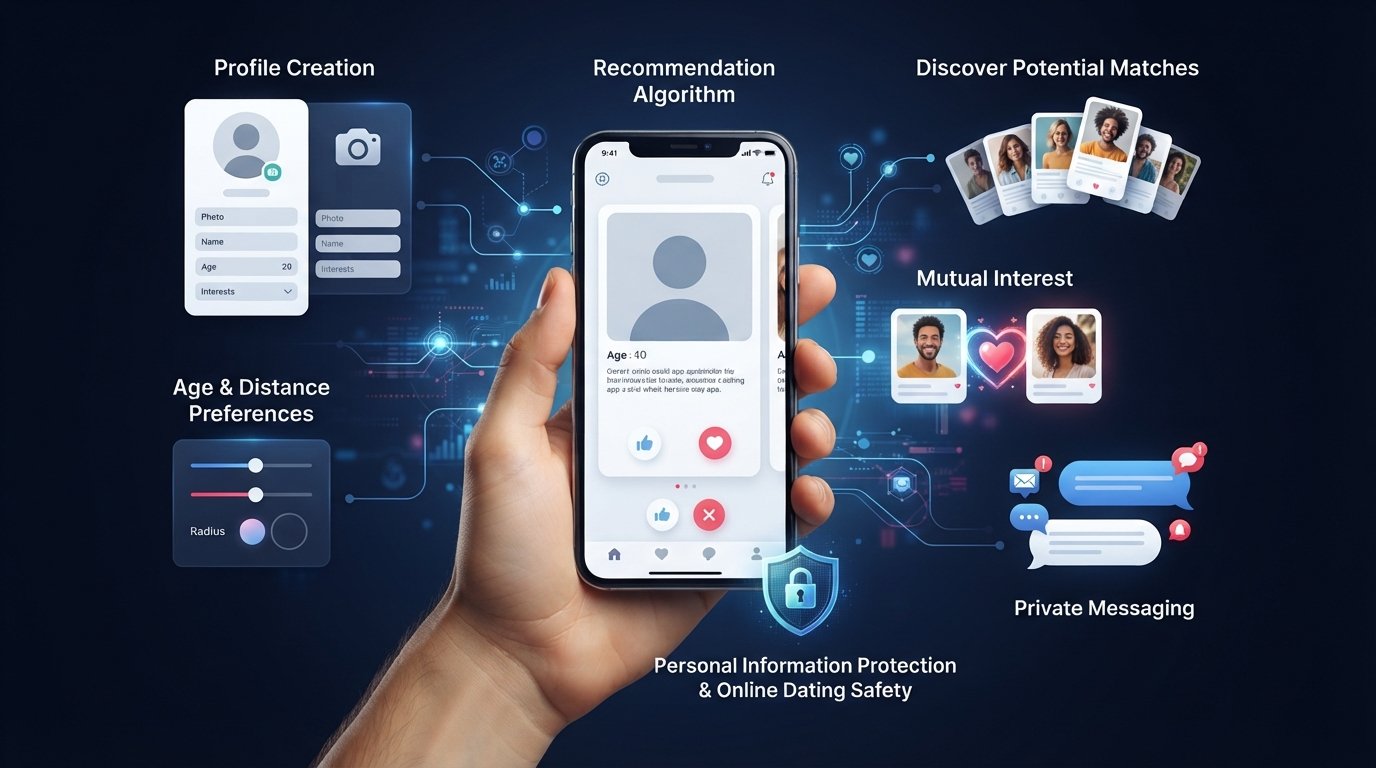
Dating apps are online platforms that help people meet, communicate with, and potentially build relationships with other people. Instead of relying only on social circles, workplaces, events, or chance meetings, users can create a profile and discover people who may share their interests, location, lifestyle, or relationship goals.
Today, dating apps offer much more than simple profile browsing. They can use information such as age, location, interests, preferences, profile activity, and interactions to recommend potential matches. Some apps focus on long-term relationships, while others are designed around casual dating, friendship, or specific communities.
Understanding how dating apps work can help you use them more effectively and make better decisions about your privacy, communication, and expectations.
What Is a Dating App?
A dating app is a mobile or web-based service that allows people to create personal profiles and connect with others for dating or relationships.
Most dating apps provide a profile containing information such as:
- Name or display name
- Age
- Photos
- Location
- Short bio or description
- Interests and hobbies
- Dating preferences
- Relationship goals
- Other optional personal details
After creating a profile, users can usually browse or receive recommendations for other profiles. Depending on the app, they may be able to like a profile, skip it, send an interest, or use another interaction feature.
If two users express mutual interest, the app may allow them to communicate through a private messaging system.
How Do Dating Apps Work?
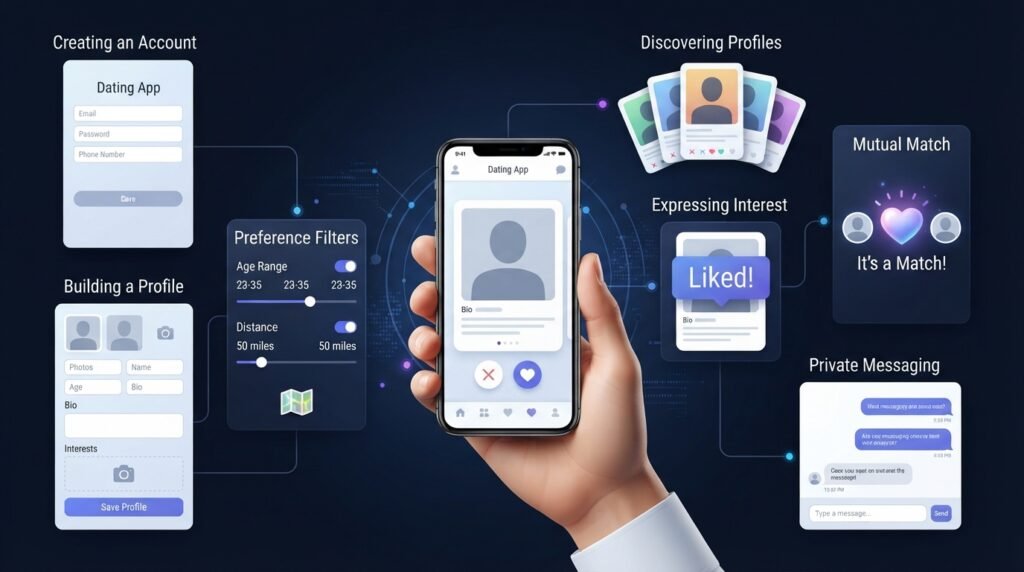
Although every dating app has its own features, the basic process is usually similar.
1. Create an Account
The first step is creating an account. Many dating apps allow users to register with an email address, phone number, or an existing online account.
Some services may also use verification features to help confirm that an account belongs to a real person.
During registration, users may be asked to provide basic information such as age, location, gender, and dating preferences.
2. Build Your Dating Profile
After creating an account, users usually build a profile.
Your profile gives other people an idea of who you are. It may include photos, a short biography, interests, lifestyle information, and what you are looking for.
A complete profile can make it easier for other users to understand whether they have something in common with you.
3. Set Your Preferences
Dating apps often allow users to choose preferences for the people they want to discover.
Depending on the platform, these preferences can include:
- Age range
- Distance
- Gender
- Relationship preferences
- Interests
- Lifestyle choices
- Other profile characteristics
The available options vary considerably between apps.
4. Discover Potential Matches
Once your profile and preferences are set, the app can show you other users.
Some apps present profiles one at a time, while others display several recommendations together. The interface may allow you to like, skip, save, or otherwise interact with a profile.
The people you see are not necessarily selected using one simple rule. Dating platforms can consider several signals when deciding which profiles to present.
5. Express Interest
When you find someone interesting, the app may provide a way to express interest.
This could be through:
- A like
- A swipe
- A message or comment
- A profile reaction
- A similar interaction feature
The exact process depends on the dating platform.
6. Get a Match
A match generally happens when two users show mutual interest.
For example, if you like another person’s profile and that person also likes yours, the platform may create a match.
Once matched, many dating apps allow both users to start a conversation.
7. Start Messaging
After matching, users can communicate through the app’s messaging system.
The conversation may begin with a simple introduction and gradually develop into a longer discussion. Some platforms also provide prompts, voice features, video calling, or other communication tools.
A match does not guarantee a relationship. It simply creates an opportunity for two people to communicate.
8. Move Beyond the App
If both people become comfortable with each other, they may eventually decide to communicate outside the dating app or meet in person.
This decision should be made carefully. Users should avoid sharing sensitive personal information too quickly and should consider basic safety precautions before meeting someone they first encountered online.
How Do Dating Apps Find Potential Matches?
One of the most important parts of a dating app is deciding which profiles to show to each user.
Different platforms use different systems, but recommendations can involve several types of information.
Location
Location can be important because many users want to meet someone who lives within a reasonable distance.
An app may use your selected location or device-related location information to estimate which profiles are nearby.
Age and Preferences
Dating apps can use the preferences you provide to narrow down potential recommendations.
For example, a user might select a preferred age range or distance. The app can use these settings when determining which profiles are relevant.
Interests and Profile Information
Some dating platforms use information from your profile to identify potential compatibility.
Common examples include:
- Hobbies
- Music interests
- Sports
- Education
- Lifestyle preferences
- Relationship goals
- Personal interests
The importance of each factor depends on the platform.
Your Activity
Your behavior within the app can also provide useful signals.
For example, the platform may learn from patterns such as which profiles you interact with, which profiles you skip, and how frequently you use certain features.
This does not necessarily mean the app knows exactly who you will like. Instead, activity can help its recommendation system estimate which profiles may be more relevant.
What Is a Dating App Matching Algorithm?
A dating app matching algorithm is a system that helps a platform organize and recommend potential profiles.
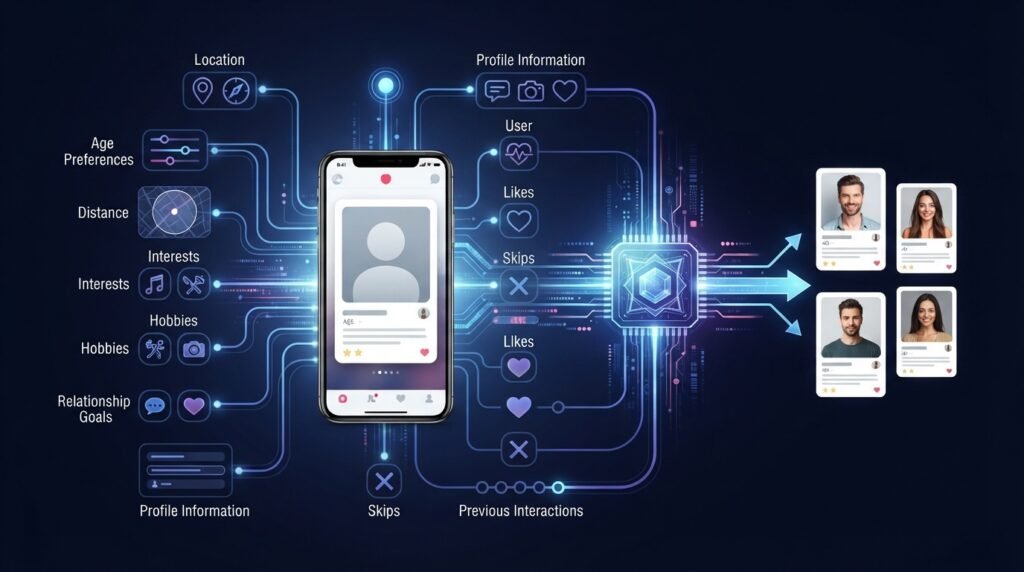
The term “algorithm” can sound complicated, but the basic idea is straightforward: the app processes available information and uses rules or statistical models to determine which recommendations may be useful.
What Factors Can Matching Systems Consider?
Depending on the platform, a recommendation system may consider:
| Factor | How It Can Affect Recommendations |
| Location | Helps identify people who are nearby |
| Age preferences | Filters or prioritizes profiles within selected ranges |
| Interests | Can help identify shared interests |
| Dating goals | May help connect people looking for similar types of relationships |
| Profile information | Provides additional information for recommendations |
| User activity | Can provide signals about profile preferences |
| Interactions | Likes, skips, and other actions may influence future recommendations |
| App settings | Determines which types of profiles a user wants to discover |
It is important to remember that there is no universal dating algorithm. Every platform can use a different combination of signals and ranking methods.
Does a Match Mean You Are Compatible?
Not necessarily.
A match means that two people have expressed mutual interest according to the app’s matching system. It does not prove that they have compatible personalities, values, communication styles, or long-term goals.
Real compatibility involves factors that are difficult for an app to measure completely.
These can include:
- Personality
- Communication style
- Values
- Lifestyle
- Emotional compatibility
- Long-term expectations
- Sense of humor
- Trust and respect
Dating apps can help people discover each other, but the quality of a relationship depends on what happens after the connection is made.
Why Do People Use Dating Apps?
People use dating apps for many different reasons.
Meeting New People
Dating apps can make it easier to discover people outside your existing social network.
Finding a Relationship
Some users join dating platforms because they want to find a long-term partner or explore a serious relationship.
Casual Dating
Other users may be interested in meeting people without immediately looking for a long-term commitment.
Connecting With People Who Share Interests
Dating apps can help users discover people with similar hobbies, lifestyles, or interests.
Convenience
Traditional dating often depends on social events, introductions, or meeting people in everyday life. Dating apps provide another way to discover potential connections from a phone or computer.
What Are the Main Types of Dating Apps?
Not every dating app is designed for exactly the same audience or purpose.
| Type of Dating App | Main Purpose |
| General dating apps | Connect a broad range of people |
| Relationship-focused apps | Help users looking for longer-term relationships |
| Casual dating apps | Designed around more casual connections |
| Community-focused apps | Serve people with particular interests or communities |
| Niche dating apps | Focus on specific preferences, lifestyles, or backgrounds |
The best type of app depends on what you actually want from online dating.
Are Dating Apps Free?
Many dating apps offer a free version, but some also provide paid subscriptions or optional purchases.
Free features may include basic profile creation, browsing, matching, or messaging. Paid plans can provide additional features, although the exact benefits vary from one service to another.
Common premium features may include:
- More profile visibility
- Additional likes or interactions
- Advanced search or preference options
- Seeing certain interaction information
- Rewinding or changing previous actions
- Removing advertising
- Other premium discovery tools
Before paying for a subscription, it is worth checking exactly which features are included and whether they are useful for your goals.
Are Dating Apps Safe?
Dating apps can be useful, but online dating also comes with privacy and safety risks.
A person may not always be exactly who they claim to be, and some people use dating platforms for scams or other harmful purposes.
Common Warning Signs
Be cautious if someone:
- Quickly asks for money
- Requests financial information
- Pressures you to leave the app immediately
- Avoids reasonable questions about their identity
- Provides stories that repeatedly seem inconsistent
- Refuses normal forms of verification
- Pressures you into uncomfortable situations
- Sends suspicious links or requests
You do not need to continue communicating with someone who makes you uncomfortable.
Protect Your Personal Information
Avoid sharing sensitive information too early, such as:
- Home address
- Financial details
- Passwords
- Account verification codes
- Government identification numbers
- Private documents
Use the app’s blocking and reporting tools when necessary.
How Can You Use Dating Apps More Effectively?
Using a dating app effectively is not only about getting as many matches as possible. The goal is to create genuine opportunities to meet people who are appropriate for what you want.
Create an Honest Profile
Use accurate information about yourself and choose recent photos. Avoid creating an exaggerated version of your personality or lifestyle.
Be Clear About Your Goals
If you are looking for a serious relationship, friendship, or something casual, being reasonably clear can reduce confusion.
Read Profiles Carefully
Instead of focusing only on photos, look at the person’s bio, interests, preferences, and other available information.
Have Real Conversations
A match is only the beginning. Ask questions, share information about yourself, and pay attention to whether the conversation feels natural.
Do Not Rush
You do not need to share personal information or meet someone immediately. Take enough time to become comfortable with the person.
What Are the Advantages and Disadvantages of Dating Apps?
Dating apps can make meeting people easier, but they also have limitations.
| Advantages | Disadvantages |
| Easy way to discover new people | Profiles may not always represent reality |
| Can expand your social circle | Too many choices can become overwhelming |
| Preferences can help narrow recommendations | Matching systems are not perfect |
| Convenient communication | Conversations can end suddenly |
| Useful for people with busy schedules | Scams and fake profiles can exist |
| Can connect people with shared interests | A match does not guarantee compatibility |
Understanding both sides can help you approach online dating with realistic expectations.
What Should You Know Before Using a Dating App?
Before creating an account, think about what you want from the experience.
Consider these questions:
- Am I looking for a relationship, casual dating, or simply meeting people?
- How much personal information am I comfortable sharing?
- What type of person am I hoping to meet?
- Which features are actually important to me?
- Am I comfortable using a paid subscription?
- What safety boundaries do I want to maintain?
Having clear expectations can make the experience more manageable.
Frequently Asked Questions About Dating Apps
How do dating apps work for beginners?
Most dating apps work through a simple process: create a profile, set preferences, discover other profiles, express interest, match with someone who also shows interest, and then communicate through the app.
Do dating apps actually work?
Dating apps can help people meet others they may not have encountered otherwise. However, success depends on factors such as the quality of your profile, your expectations, communication, the platform you choose, and the people you meet.
How do dating apps decide who to show you?
Dating apps can use factors such as location, preferences, profile information, interests, activity, and previous interactions. Each platform can use its own recommendation and ranking system.
Does matching mean you will have a relationship?
No. A match only indicates mutual interest within the app. A successful relationship depends on communication, compatibility, trust, shared expectations, and many other factors.
Can I use dating apps without paying?
Many dating apps offer free versions with basic features. However, some functions may require a subscription or one-time purchase.
Are dating apps safe to use?
Dating apps can be used safely when users protect their personal information, recognize suspicious behavior, use reporting tools, and take appropriate precautions when meeting someone in person.
When should I meet someone from a dating app?
There is no universal timeline. You should meet only when you feel comfortable and have taken reasonable steps to confirm that the situation feels safe. A first meeting is generally better in a public place where you can leave easily if necessary.
Why do dating apps ask for so much information?
Dating apps may collect profile information and activity data to provide their services, personalize recommendations, maintain accounts, improve features, or support safety and security. The exact information collected depends on the individual platform and its privacy practices.
Conclusion
Dating apps provide a convenient way to discover and communicate with people who may share your interests, preferences, or relationship goals. While the exact features differ between platforms, most dating apps follow the same basic journey: create a profile, set preferences, discover potential matches, express interest, match with someone, and start communicating.
Behind the scenes, dating platforms can use information such as location, preferences, profile details, interests, and user activity to provide recommendations. However, an algorithm cannot completely determine whether two people will be compatible.
The best approach is to treat a dating app as a tool for starting connections rather than a guarantee of a relationship. Create an honest profile, communicate respectfully, protect your personal information, and keep realistic expectations. With the right approach, dating apps can become a useful way to meet new people while staying in control of your online dating experience.